
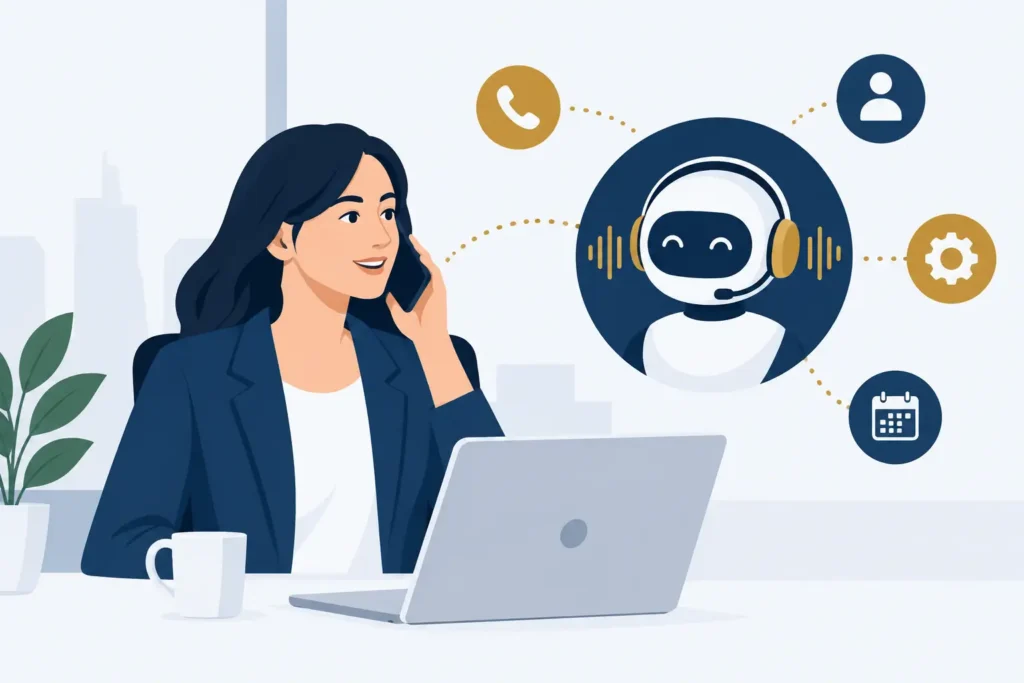
A missed call at 11:45 a.m. can be more expensive than it looks. It may be a patient trying to schedule an appointment, a buyer requesting a quote, or a customer who needs an answer before placing an order. When no one picks up, many callers do not leave a voicemail. They call the next business. AI voice agents give small and mid-sized businesses a practical way to answer routine inbound calls when staff are busy, after hours, or already helping someone else.
The value is not that an automated system replaces every conversation. It is that routine calls no longer compete with the work only your staff can do. Used well, an AI voice agent can capture the caller’s intent, answer approved questions, book an appointment, and send qualified opportunities to the right person.
What AI Voice Agents Actually Do
An AI voice agent is software that speaks with callers over the phone using a configured business knowledge base and call flows. Unlike a basic phone tree that asks callers to press a number, it can understand natural spoken requests and respond conversationally within the information it has been given.
For a medical practice, that may mean answering office-hour questions, collecting basic appointment details, and routing urgent requests according to the practice’s rules. For a real estate brokerage, it may mean asking a prospective buyer about location, budget, and timing before sending the lead to an available agent. For an eCommerce business, it may handle common order-status or return-policy questions without placing every caller in a queue.
The best use cases have two things in common: calls follow a repeatable pattern, and there is a clear next step. The agent needs defined answers, approved boundaries, and a reliable handoff path. It should not be expected to make judgment calls on sensitive, unusual, or high-stakes matters.
The Business Problem It Solves
Most smaller organizations do not have a dedicated receptionist or a fully staffed call center around the clock. The people answering the phone are often also scheduling work, serving customers, processing orders, or managing a team. That arrangement works until call volume rises or calls arrive outside normal business hours.
The result is not always obvious in a dashboard. It appears as interrupted work, long hold times, incomplete messages, and leads that never receive a response. A front desk team may answer 90 percent of calls and still lose meaningful revenue from the other 10 percent.
An AI voice agent creates coverage for predictable interactions. It can answer immediately, identify why someone is calling, collect the information your team needs, and route the call or follow-up request. That reduces abandoned calls while giving employees more time for conversations that require expertise, empathy, or authority.
This is particularly useful for businesses with seasonal demand, small office teams, or appointment-driven revenue. A travel business may receive a surge of calls after a weather event. An accounting firm may see volume spike near filing deadlines. A property management office may need to sort maintenance-related calls from routine leasing inquiries. The system does not eliminate the workload, but it can organize it before it reaches your staff.
Where Automation Helps and Where It Does Not
The strongest AI voice agent deployments begin with a narrow scope. Start with the calls that are frequent, straightforward, and costly to miss. Common examples include new appointment requests, business hours, location details, service-area questions, basic qualification, and routing to the correct department.
Automation is a poor fit when the caller needs advice that depends on context, when a conversation involves a complaint that needs careful handling, or when the answer carries legal, financial, or clinical consequences. Financial services firms, healthcare practices, and other regulated businesses should be especially precise about what the agent may say, what information it can collect, and when it must transfer the call to a person.
The practical question is not, “Can AI handle this call?” It is, “What happens if it gets the call wrong?” If the cost of a wrong answer is high, design the call flow to escalate early. A caller should never have to argue with an automated system to reach a person.
A Human Handoff Is Part of the Design
A voice agent needs clear escalation rules. It should transfer calls when a caller asks for a person, when it cannot understand the request after a reasonable attempt, or when a request falls outside the approved topics. It should also tell callers what it is doing rather than leaving them uncertain about whether a message was received or an appointment was booked.
The handoff matters as much as the automated conversation. Staff should receive useful context: the caller’s name, callback number, reason for calling, and any answers already collected. Without that context, the customer repeats the entire interaction and the business loses the efficiency it intended to gain.
What It Takes to Set One Up Well
The technology is only one part of the project. The quality of an AI voice agent depends on the operating details you provide. Before launch, document the questions callers ask most often, the exact answers staff should give, and the situations that require transfer or follow-up.
Use real call patterns, not an idealized script. Ask the front desk, service team, and sales staff where calls tend to go off track. They know the phrasing customers use, the exceptions that come up, and the details that cannot be guessed.
Then test the agent like a customer would. Call with incomplete information. Use different ways of asking the same question. Ask about an issue that the agent should not handle. Review whether it identifies the intent, gives an accurate response, and routes the call correctly.
A short list of launch checks is worthwhile:
- Confirm the business hours, locations, service areas, pricing references, and policies are current.
- Define exactly which requests can be handled automatically and which require a person.
- Set rules for urgent calls, after-hours messages, and requests for a live transfer.
- Decide who reviews call outcomes and updates the agent when policies or services change.
This work is ongoing. If your services, staff schedules, or booking process change, the voice agent needs the same update. Treat its call instructions as operating documentation, not a one-time setup task.
Measuring Whether the Investment Is Working
Do not judge the system by whether it sounds impressive on a single call. Measure whether it improves the operational problem that led you to consider it.
Start with inbound call volume, missed calls, abandoned calls, lead capture, appointment requests, and the time your team spends on routine phone questions. After implementation, review how many callers received an answer, how many were routed successfully, how many appointments were booked, and how often the agent needed human help.
Customer feedback also matters. A fast automated response is not useful if callers leave frustrated or cannot reach staff when needed. Listen to a sample of conversations, especially failed transfers and calls that ended without a clear outcome. Those are usually the fastest source of improvements.
Cost should be evaluated against captured opportunities and staff time, not against the cost of voicemail. For example, Cloud Vision Technologies offers its AI Voice Agent at $99.99 per month plus $0.19 per minute, with no long-term contract. Whether that is worthwhile depends on call volume, the value of a qualified lead, and how many calls currently go unanswered.
Choosing the Right Role for AI on the Phone
AI voice agents work best as a first response and an intake layer. They make sure callers are acknowledged, routine questions receive consistent answers, and staff get involved with enough context to act quickly. That is a different role from a full contact center, which may require skills-based routing, agent management, call recording, CRM integration, and outbound dialing tools.
Some businesses need both. Others only need dependable coverage for a handful of inbound call types. There is no advantage in buying more capability than the workflow requires. The right setup is the one that reduces missed opportunities without making the customer experience harder.
Start with the calls your team wishes it did not have to answer manually, but cannot afford to miss. If you can define the question, the approved answer, and the next step, an AI voice agent may be able to handle the first part of the conversation while your people handle the part that truly needs them.