
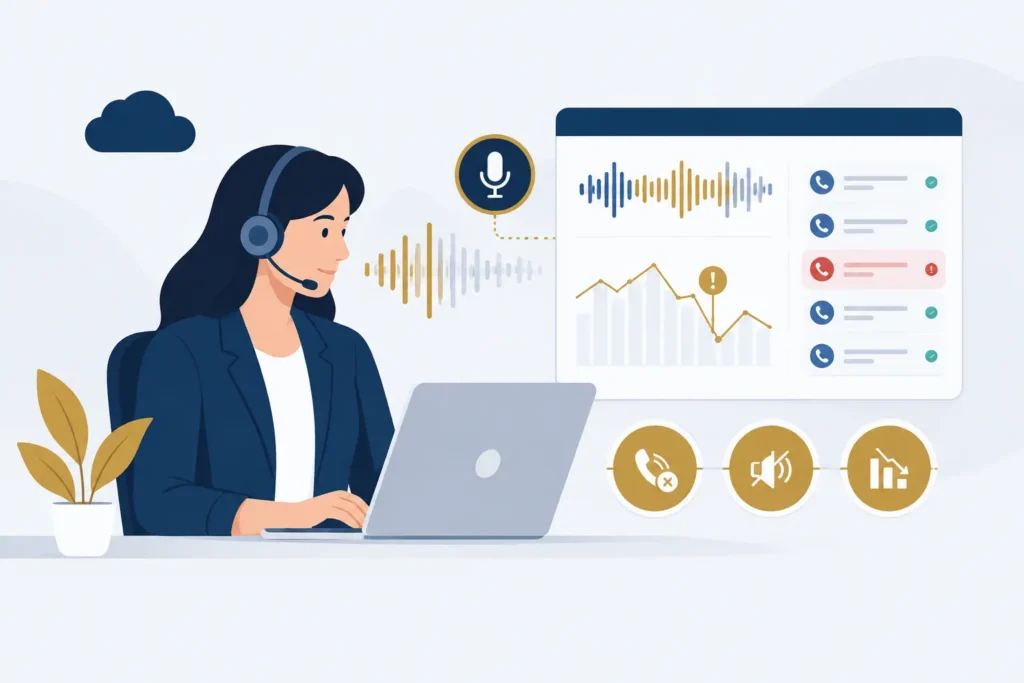
A missed call is easy to see. The more expensive problem is the call that gets answered but goes nowhere: a prospect who waits on hold, a patient who never gets scheduled, or a customer who asks the same question three times before hanging up. Voice analytics helps businesses find those patterns in the conversations and call data they already have.
For a small or mid-sized business, this is not about creating another report for management to ignore. It is about answering practical questions: Are calls being answered quickly enough? Which reasons bring people to the phone? Are transfers creating friction? Does the team follow the process that protects revenue and customer trust?
What Voice Analytics Actually Measures
Voice analytics is the process of using call data, recordings, transcripts, and speech patterns to understand what happens during phone conversations. It can combine basic operational metrics, such as call volume and wait time, with conversation-level details, such as frequently used words, recurring customer questions, and whether a call reached a useful outcome.
The exact capabilities depend on the phone or contact center system. A basic setup may show inbound call counts, abandoned calls, answer speed, call duration, and agent activity. A more advanced contact center platform can use recordings and transcription to review conversations at scale rather than requiring a manager to listen to calls one by one.
That distinction matters. A long call is not automatically a bad call. A real estate agent may need 20 minutes to qualify a buyer, while an accounting firm may want a billing question resolved in five. Context determines whether a metric signals a problem or simply reflects the work being done.
Why Call Data Alone Is Not Enough
Call volume tells you demand exists. It does not explain why customers call, whether their issue was resolved, or why one employee consistently needs more time than another.
Consider a dental practice receiving a high number of calls between 8:00 and 9:00 a.m. A dashboard can show that peak. Voice analytics can help reveal the reason: perhaps patients are calling to reschedule appointments after receiving reminders, or perhaps the auto-attendant is sending callers to the wrong extension. Those require different fixes.
The same applies to sales and service teams. If callers repeatedly ask about order status, fees, hours, required documents, or availability, that information should affect staffing, scripts, website content, and self-service options. The call is not just a transaction. It is evidence of an operational gap or a customer need.
The Business Problems Voice Analytics Can Expose
The best use cases start with a problem that has a cost. Businesses rarely need more data for its own sake. They need a clearer way to reduce lost opportunities and improve how their staff handles demand.
Missed and abandoned calls
An abandoned call occurs when a caller hangs up before reaching someone. A few may be unavoidable. A repeated pattern at certain times, departments, or locations points to understaffing, weak routing, or an unclear menu.
For a medical office, every abandoned new-patient call may represent revenue that never reaches the schedule. For a retailer, it may be a customer who buys elsewhere because no one could confirm inventory. Reviewing call volume alongside answer times makes the staffing problem visible.
Inconsistent call handling
Two employees can receive the same question and deliver very different customer experiences. One confirms the issue, gives a clear next step, and documents the conversation. Another transfers the caller twice or promises a callback that does not happen.
Recorded calls and transcripts give managers specific coaching material. Instead of saying, “Be better on the phone,” they can address a real pattern: explain the next step before transferring, verify contact information, or ask a qualifying question earlier in the call.
Repeated questions and avoidable demand
When dozens of customers call about the same issue, the phone team becomes a workaround for another process that is not working. A travel business may get repeated questions about changes. A SaaS company may hear the same onboarding question. An eCommerce team may spend hours checking shipment status.
The answer is not always to push customers away from the phone. Sometimes a quick conversation is the right service. But repeated, simple questions often signal an opportunity to improve confirmations, FAQs, automated messages, or routing.
Sales calls that fail to move forward
Sales managers often track talk time but miss the more useful question: what happens before a prospect agrees to the next step? Conversation analysis can show whether representatives are asking about needs, confirming decision-makers, handling common objections, and setting a defined follow-up.
It should not become a rigid script scorecard. Strong calls need room for judgment. The goal is to identify repeatable behaviors that lead to appointments, qualified opportunities, or completed orders.
How to Use Voice Analytics Without Creating Busywork
Start with one operational question. For example: Why are callers hanging up before speaking to us? Why are appointment requests taking too long? Why do we receive so many billing calls? A focused question keeps the review useful and prevents teams from chasing every available metric.
Next, establish a baseline. Review several weeks of call volume, answer times, abandoned calls, transfers, and call outcomes. Then listen to or review a representative sample of conversations. Numbers identify where to look; the conversations explain what is happening.
Assign ownership to the person who can make a change. If the issue is call routing, an office manager or operations lead may own the fix. If it is training, the team supervisor should lead it. If callers are confused by policies or website information, the person responsible for those materials needs the evidence.
Finally, measure the result after the change. If you adjust the auto-attendant, add coverage during lunch, or revise a scheduling process, compare the same metrics over the next few weeks. Voice analytics is useful when it supports a cycle of observation, correction, and verification.
Privacy and Call Recording Need Clear Rules
Call recording can be valuable for quality assurance, coaching, and dispute resolution, but it comes with responsibilities. Recording and consent requirements vary by state and by the type of information discussed. Healthcare, financial services, and other businesses handling sensitive information should also consider their internal policies and compliance obligations.
Tell callers when calls may be recorded when required. Limit who can access recordings and transcripts. Set retention periods that match business and legal needs rather than keeping everything forever. Most importantly, do not use recordings as a surveillance tool. Employees should understand what is reviewed, why it is reviewed, and how the feedback will be used.
Choosing the Right Foundation for Voice Analytics
A business does not need a large call center to benefit from better call visibility. Hosted VoIP systems can provide real-time dashboards that help owners and managers monitor call activity, answer patterns, and service levels. That may be enough for a smaller team focused on reducing missed calls and improving responsiveness.
When a team needs call recording, skills-based routing, CRM integration, and more structured performance management, a contact center platform is usually the better fit. It gives supervisors more context around each interaction and makes it easier to connect call handling with sales or service workflows.
Cloud Vision Technologies offers real-time dashboards across its products, while its Contact Center Platform includes call recording, CRM integration, omnichannel support, and skills-based routing. The right choice depends on the work being done. A five-person office should not pay for contact center complexity it will not use, but a multi-seat service team should not rely on a basic phone setup when call quality directly affects revenue.
Voice analytics works best when it stays close to the daily work of the business. Review the calls that were missed, the calls that took too long, and the calls that should have ended differently. Then make one change your customers can feel the next time they pick up the phone.